
Why is a felt sense vocabulary important?
Having the ability to accurately describe what we are experiencing in our bodies helps us build a skill called interoception which is our ability to listen to and understand our internal cues. On a basic level it tells us when we are hungry or need to go to the bathroom and on a more fine-tuned level, interoception informs our understanding and evaluation of people and situations. It connects us to our intuItion, our deep sense of inner knowing. Something that often gets dulled through experiences of developmental trauma or having to override oneself in order to navigate the world.
Interoception plays a big part in how secure we feel. Combined with the information we take in from our external environment (exteroception) it helps us accurately measure our sense of safety or threat, known as neuroception. Neuroception is an inborn skill that can become more fine tuned and relied on the more we are able to make sense of what we feel in our bodies.
Finding Words
Through the healing process I support clients in turning towards their bodies to process, to feel, to gain clarity, to release, and revivify. Initially, this can be complicated by a nervous system that is more often than not in a state of hyper-fixation. When we do not have the ability to describe what we are experiencing in our bodies this can create a negative feedback loop into hyper-fixation on threat. Our brains do not distinguish between real and perceived threats, internal cues of threat and external threats can become jumbled. This can be confusing and lead to exacerbated hyper-vigilance and immobilization symptoms. Which adds to the difficulty of being able decipher between real threats and perceived threats.
If our primary care-givers didn’t accurately attune to us and help us find the words for what we were experiencing learning to accurately attune to our own sensations can be a game changer.
Once we are more skilled at feeling into our own experience we have greater capacity to sense into others. Interoception is very much a relational skill.
Understanding and communicating our experience is a foundational component of healing, building resiliency, and deepening our relationships. Just like how learning emotional vocabulary is important for emotional intelligence, so too is having a diverse somatic vocabulary to describe our felt sense.
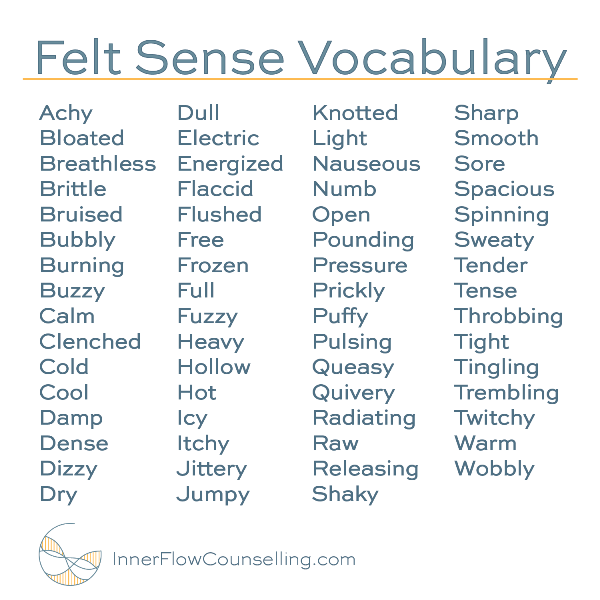
I’ve created a printable felt sense vocabulary list to help you find accurate words to describe your sensations. This is also great to teach children because when they can clearly communicate their experience they are less likely to get frustrated (just like us adults). This list is by no means exhausted; please add words as they come to you. I suspect kids will have some great suggestions.
If you are interested in receiving support while you make sense of your inner sense, please reach out and ask me about my 1:1 sessions and my group offerings.